 What Mission Viejo's Housing Stock Means for Your Garage Door Spring
Mission Viejo homes built from the 1980s onward often have original torsion springs nearing failure; here's what drives the cost, the risk, and when to call.
Why Pre-1990s Garage Doors in Mission Viejo Leak Heat and Cold
Mission Viejo's housing stock spans 1938 to 2015, and many older garage doors here predate any insulation requirement. Here's what that means for cost.
Local detail
The Cost of This Job
We don't post a flat number here because the right fix depends on what's actually hanging on your track, and we're not going to quote a repair sight-unseen. What drives the cost on a job like this is usually one of three things: whether the door itself is sound and just needs insulation added, whether the panels have warped or delaminated enough that patching doesn't make sense, and whether the opener and hardware are compatible with a heavier insulated door or need upgrading too.
A door that's structurally fine but was built before insulation was standard can sometimes take a retrofit kit - foam panels dropped into the existing frame. That's the cheaper path. A door with rot in the wood core, rust at the bottom panel, or a steel skin that's bowed from decades of sun exposure usually isn't worth retrofitting; replacement ends up costing less over time than fighting an old frame.
One honest limitation: we can't tell you which path your door needs over the phone. The difference between a $200 fix and a full replacement is something we have to see in person, on your track, in your garage. Anyone who quotes you firm numbers without looking at the door is guessing.
The area
The Problem
Housing in this city went up anywhere from 1938 to 2015, with the median sitting around 1983 - right before insulated steel doors became the common builder-grade option. If your house falls on the older side of that range, or in the big wave of 1980s and 90s construction that makes up most of the local stock, there's a good chance the garage door itself is a single layer: thin steel or a slab of wood, with nothing between the outside skin and your garage.
That matters more than people think. A garage attached to the house shares a wall with living space, and an uninsulated door turns that whole bay into a thermal pass-through. In summer the door face absorbs heat all day and radiates it into the garage, which then pushes into anything built against that shared wall - a laundry room, a bedroom over the garage, ductwork routed through the ceiling. In winter it works the other way.
This isn't a defect. It's just what builders shipped when your house went up, before insulated doors were the expected standard. The fix isn't urgent in the way a broken spring is, but it's a real, measurable gap in the house, not a cosmetic complaint.
What we find
When to Get Help
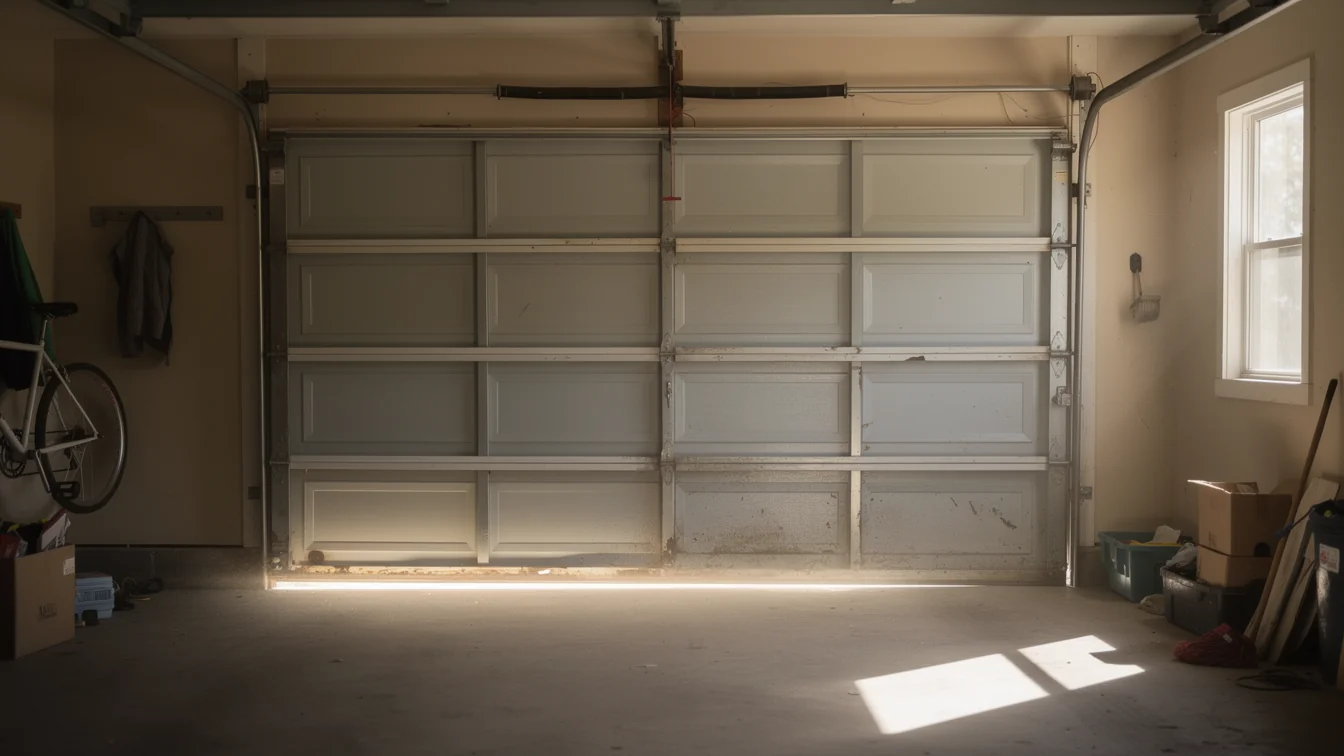
A handful of signs tell you the door itself, not just the insulation, needs attention. Daylight visible along the bottom seal when the door is closed means the weatherstrip has hardened or shrunk - common once a door passes a couple of decades old. Panel surfaces that feel cool and damp to the touch on mild mornings point to condensation forming on bare steel with nothing behind it to slow the temperature swing; that moisture sits against the panel and eventually causes rust from the inside out.
If you own one of the wood-panel doors common on the older end of the 1938-2015 build range, check the bottom rail for soft spots or dark staining. Wood doors from that era weren't treated the way exterior lumber is treated now, and a rotted bottom rail is a structural problem, not just a thermal one - it changes how the door hangs on its hinges and tracks.
Call sooner rather than later if the door is sagging on one side, if a panel has visibly bowed, or if you're planning any room-over-garage renovation, since that's when an uninsulated door stops being an efficiency question and becomes a comfort problem you'll feel daily.
How we work
What Local Conditions Do
This area sits in a mild temperate climate band - no hard freezes to crack an old panel, no deep snow load to worry about on the header. That's good news for hardware; springs and tracks here don't take the beating they would somewhere with real winters. But mild doesn't mean neutral. Steady sun exposure on an un-shaded, uninsulated door face does its own kind of damage over years: steel skins warp slightly from repeated heat cycling, and wood panels dry out and check at the seams.
We work this part of south Orange County - Las Flores and Laguna Hills a few minutes out, Rancho Santa Margarita, Coto de Caza, and Ladera Ranch a little further, Aliso Viejo and Laguna Woods nearby as well. The build pattern repeats across that whole stretch: a mix of 1980s and 90s tract construction with some older pockets mixed in, and a lot of original, uninsulated doors still hanging on houses that have had everything else updated.
With a median household income above $136,000 across the service area and tens of thousands of owner-occupied houses in that same build era, replacement with a properly insulated door is often the choice homeowners land on once they've weighed it against patching an old slab.
Questions
Common questions
Is my garage door actually uninsulated, or does it just feel that way?
If your house was built before the 1990s, open the door and look at the inside face. A single flat steel or wood surface with no backing material means it's uninsulated. Insulated doors have a visible foam or polystyrene layer and usually a second interior skin, which you'll notice is thicker and warmer to the touch.
Does Mission Viejo's climate make this worse?
The mild temperate conditions here mean you're not dealing with freeze damage, but steady sun on an un-shaded door face still heats the garage and anything built against that shared wall. It's a comfort and energy issue more than a structural one, driven by heat cycling rather than cold.
Can I just add insulation to my existing door instead of replacing it?
Sometimes. If the panels are flat, unwarped, and free of rot or rust, a retrofit kit works. If the door has rot in a wood core or rust and bowing in a steel panel, retrofitting won't hold and replacement is the more honest answer, even though it costs more upfront.
How do I know if it's worth fixing versus replacing?
We'd need to see the door in person - age alone doesn't decide it. A sound frame with cosmetic wear can often be insulated as-is. A door with structural rot, bowed panels, or hardware that's failed in multiple spots usually costs more to patch piecemeal than to replace outright.
Recommendation
You Might Also Like
More garage door guides for Mission Viejo homeowners.
What Mission Viejo's Housing Stock Means for Your Garage Door Spring
Mission Viejo homes built from the 1980s onward often have original torsion springs nearing failure; here's what drives the cost, the risk, and when to call.
 What Actually Happens When We Come Out to Your Door
A breakdown of what actually happens during a garage door service call in Mission Viejo, tied to the area's 1980s-90s housing stock and mild coastal climate.
 What That Noise Coming From Your Garage Door Is Actually Telling You
Most Mission Viejo garages date to the 1980s and 90s.
Ready when you are
Need a garage door sorted in Mission Viejo?
Mission Viejo Garage Door Pros repairs and installs garage doors, springs and openers in Mission Viejo, CA and the surrounding area.